> For the complete documentation index, see [llms.txt](https://docs.infrastructure.finance/llms.txt). Markdown versions of documentation pages are available by appending `.md` to page URLs; this page is available as [Markdown](https://docs.infrastructure.finance/usd.infra-vault/how-the-usd.infra-vault-works.md).
# How the USD.infra Vault Works
**TLDR:**
* The USD.infra Vault routes on-chain capital into digital infrastructure and bankruptcy-remote SPVs, then returns cashflows back into the Vault.
* Flow: stablecoins → mint/receive USD.infra → deposit into the Vault → receive sUSD.infra → Vault allocates into SPVs and reserve assets → revenue accumulates.
* sUSD.infra exchange rate is calculated from project cashflows (undeployed reserves + deployed capital + accrued revenue − impairments).
* Key idea: Stable money in → infrastructure financed → cashflows back → sUSD.infra exchange rate reflects Vault performance.
## **Capital Flow Overview**
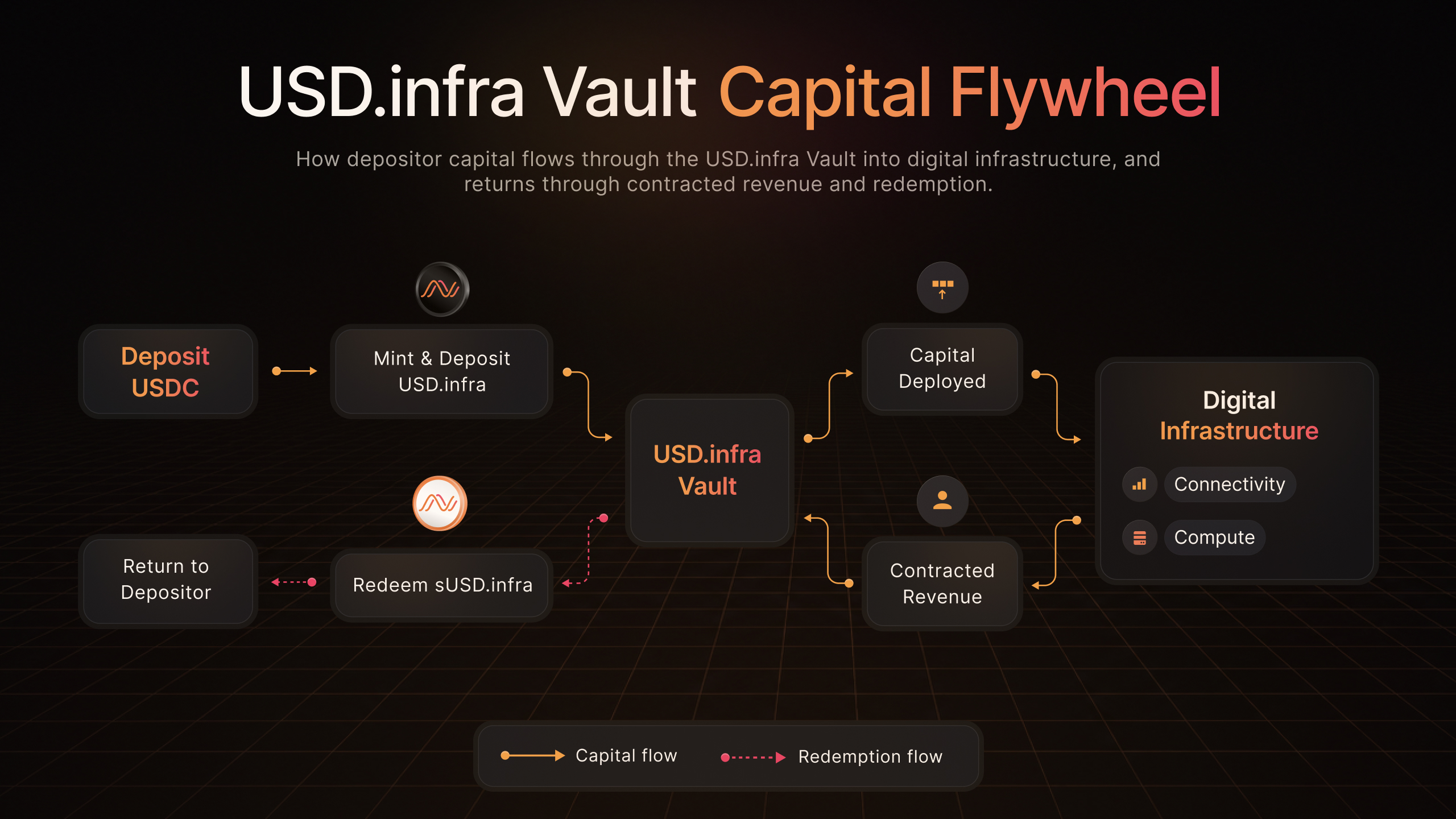
The USD.infra Vault connects on-chain stablecoin capital to real digital infrastructure deployments through the Vault and bankruptcy-remote SPVs, then returns infrastructure cashflows back into the Vault for depositors.
### **End-to-end flow**
1. Capital enters as stablecoins (USDC)
2. Users mint/receive USD.infra (1:1) and deposit into a Vault.
3. Vault deposits issue sUSD.infra (the Vault participation token) representing a participation claim on the Vault's shared pool.
4. Vault capital is deployed into project SPVs that fund deployments executed by governance-approved operators, which build, service, and support the deployments funded through the Vault. Infrastructure and contracts are held at the SPV level. Operators and independent backup operators work under documented servicing agreements.
5. Contracted revenue (infrastructure cashflows) accumulates in the revenue pool.
6. Cashflows flow back into the Vault, reflected in the Vault exchange rate. All users share the same pool economics, while liquidity and redemptions are managed through the Vault’s liquidity sleeve and redemption policy.
## Asset Types
The USD.infra Vault routes capital into AI and digital infrastructure that follows one repeatable pattern: capital deployed upfront, capacity delivered over time, and contracted payments that can be measured and routed back to the Vault, with safeguards that reflect real-world liquidity constraints. Every asset class below is underwritten on that pattern. Underwriting starts with the contract rather than the sponsor: whether the revenue is verifiable, whether the asset can be serviced to the end of its term, and what the equipment is worth if it has to be redeployed. Capital buys physical equipment and the installation that brings it online (radios, servers, GPUs, batteries), and each project sits in its own special purpose vehicle that holds title to the equipment and to the contract behind it.
### Connectivity
Connectivity is the foundation of the portfolio: proven deal types with operating history and predictable unit economics.
* **Apartment buildings:** managed Wi-Fi contracts with whole buildings under long-term agreements, typically 10 years, with predictable per-unit economics.
* **ISP acquisitions:** purchasing regional internet service providers at favorable multiples, then improving operations through consolidated infrastructure.
* **Carrier offload:** selling Wi-Fi capacity to mobile carriers (T-Mobile, AT\&T), who pay per gigabyte to offload cellular traffic onto fixed wireless.
### Compute
Digital infrastructure increasingly means processing and storing data close to where it is used, not only moving it. Compute assets follow the same economics as connectivity: hardware deployed upfront, capacity delivered over time, and contracted payments against that capacity.
* **Edge compute and mini data centers:** modular compute deployed close to network infrastructure (servers, routing, orchestration and monitoring), monetized through contracted hosting and processing arrangements.
* **GPU compute (neocloud):** GPU capacity leased under contract to AI frontier labs and other high-performance workloads.
* **Training content delivery networks (CDN):** caching and delivery capacity at the network edge that stages training data, model weights and checkpoints close to the compute that uses them, contracted with AI and application providers.
Compute assets are evaluated under the same underwriting principles as connectivity: verifiable contracted cash flows, measurable utilization, and conservative valuation that reflects hardware refresh cycles.
### Power (coming soon)
Every asset above runs on electricity, and in AI infrastructure power has become the bottleneck. Grid interconnection can take years, so compute sites now pay a premium for power delivered on site today. The power class finances the generation and storage behind the vault's compute and connectivity sites. It is the power layer under the two classes above, not a separate bet on the energy market.
* **Behind-the-meter power for compute:** on-site generation and battery storage at data centers and neocloud sites, monetized through long-term power delivery agreements with the site operator.
* **Distributed battery storage:** battery systems at apartment buildings and commercial sites on the network, monetized through peak demand reduction contracts and utility grid programs.
## **sUSD.infra: Pricing, Exchange Rate, and How It Is Measured**
sUSD.infra is the receipt token that represents a participation claim on the USD.infra Vault's shared pool.
* USD.infra (stable): USD.infra is the digital infrastructure-native stablecoin used to deposit into the USD.infra Vault.
* sUSD.infra (vault participation token): sUSD.infra is the Vault participation token that represents a participation claim, subject to eligibility and transfer restrictions.
* Exchange Rate for sUSD.infra is the per-token value of the vault’s assets (cash + USD.infra + accrued yield + the modeled value of deployed positions), net of applicable fees/obligations.
* Market price vs Exchange Rate: sUSD.infra may trade on DEXs at a premium/discount to exchange rate. The protocol’s redeem path is constrained by vault liquidity (see [Liquidity & Redemptions](/usd.infra-vault/liquidity-and-redemptions.md)). This is the same mental model many “yield token / share token” systems use: a token can trade freely on AMMs even while protocol redemptions are queued or rate-limited.
The Vault reports an exchange rate per sUSD.infra token based on:
* Undeployed reserves (capital held in M0 reserve assets and T-bills backing USD.infra)
* Deployed capital (active digital infrastructure sites/networks)
* Accrued revenue (infrastructure revenue earned)
* Minus impairments (recognized defaults net of recovery value)\
## **Asset valuation methodology**
The USD.infra Vault valuation is built around verifiable cashflows and conservative accounting.
## **Vault Structure**
The USD.infra Vault uses a shared yield pool with explicit liquidity management. All participants accrue yield through the same vault performance and follow the same redemption mechanics. This structure is designed to keep liquidity management transparent and redemption treatment consistent.
## **What’s in the Vault**
* **Deployed positions:** capital deployed into SPVs funding digital infrastructure and/or cashflow acquisitions.
* **Accrued revenue:** infrastructure cashflows feeding the revenue pool and yield distributions.
* **Idle liquidity:** USD.infra held undeployed (and any short-duration yield on idle balances where applicable).
## **How Exchange Rate is computed**
* Cash + stable balances are valued at par.
* Deployed SPV exposure is valued using a consistent policy (contract-backed cashflows, underwriting assumptions, and periodic updates), with conservative haircuts where appropriate.
* Accrual timing is handled explicitly (what’s earned vs what’s distributed).
* Reporting cadence matches the reality of off-chain cash movement (daily/weekly for cash, periodic for deeper asset re-valuations).
The vault publishes an exchange rate methodology and updates so users can understand how sUSD.infra’s underlying value is measured over time.
## **Liquidity**
The primary way to move from sUSD.infra → USD.infra → fiat is via DEX liquidity: swap sUSD.infra for USD.infra on supported DEX pools at market price.
Second, users can also convert sUSD.infra → USD.infra through the vault’s redemption process, subject to the protocol’s liquidity and redemption mechanics. Once you hold USD.infra, it can be redeemed or converted to fiat through supported rails and venues depending on the distribution and product configuration.
Note: sUSD.infra’s market price may trade above or below exchange rate at times. The vault’s published exchange rate is the canonical accounting measure of underlying value.
## **Liquidity Sleeve**
The USD.infra Vault maintains a liquidity sleeve so that a meaningful portion of total vault capital remains undeployed and available for redemptions. The current target is approximately 40–50% of TVL held undeployed.
Rather than prioritizing one class of participant over another, all vault participants receive the same redemption treatment. The purpose of the liquidity sleeve is to improve redemption readiness while still allowing the remainder of vault capital to finance real digital infrastructure.
## **Yield Target**
The vault is framed around a floating target performance range. Current guidance is a target of approximately 12%. This is a target only, not a guarantee or a promise of returns, and depends on vault composition, deployment performance, and liquidity management. Participation is limited to eligible non-U.S. persons.